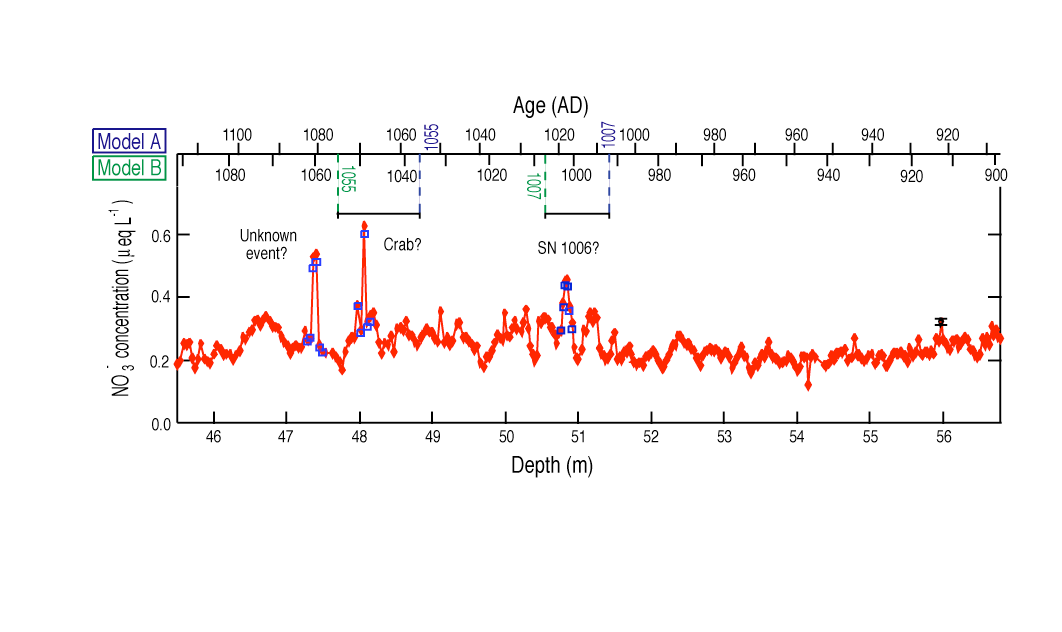
There hasn’t been a decent supernova in our part of the universe in living memory but astronomers in the 11th century were a little more fortunate. In 1006 AD, they witnessed what is still thought to be the brightest supernova ever seen on Earth (SN 1006) and just 48 years later saw the birth of the Crab Nebula (SN 1054).
Our knowledge of these events come from numerous written accounts, mainly by Chinese and Arabic astronomers (and of course from the observations we can make today of the resultant nebulae).
Now we can go one better. A team of Japanese scientists has found the first evidence of supernovae in an ice core.
The gamma rays from nearby supernova ought to have a significant impact on our atmosphere, in particular by producing an excess of nitrogen oxide. This ought to have left its mark in the Earth’s ice history, so the team went looking for it in Antarctica.
The researchers took an ice core measuring 122 metres from Dome Fuji station, an inland site in Antarctica. At a depth of about 50 metres, corresponding to the 11th century, they found three nitrogen oxide spikes, two of which were 48 years apart and easily identifiable as belonging to SN 1006 and SN 1054. The cause of the third spike is not yet known.
That’s impressive result and their ice core was obligingly revealing about other major events in the Earth’s past. The team saw a 10 year variation in the background levels of nitrogen oxide, almost certainly caused by the 11-year solar cycle (an effect that has been seen before in ice cores). They also saw a number of sulphate spikes from known volcanic eruptions such as Taupo, New Zealand, in 180 AD and El Chichon, Mexico, in 1260 AD.
The team speculate that the mysterious third spike may have been caused by another supernova, visible only from the southern hemisphere or hidden behind a cloud.
That would make the 11th century a truly bounteous time for supernovae. Of course, statistically, there ought to be a supernova every 50 years or so in a galaxy the size of the Milky Way, which means that the Antarctic ice is due another shower of nitrogen oxide any day now.
Ref: arxiv.org/abs/0902.3446: An Antarctic Ice Core Recording both Supernovae and Solar Cycles
Comments
14 responses to “First evidence of a supernova in an ice core”
[…] Stel dat je ergens in de 11e eeuw zou hebben geleefd en je zou het waarnemen van supernovae als favoriete hobby hebben gehad dan zat je gebeiteld. Want in 1006 na Chr. vond de helderste supernova plaats die ooit is waargenomen en beschreven door mensen, 48 jaar later gevolgd door de supernova van 1054, die de beroemde Krabnevel heeft veroorzaakt. Van vele historische supernovae hebben we beschrijvingen, terug te vinden in kronieken en dagboeken, vooral van Chinese en Arabische waarnemers. Daar kunnen we nu echter één concrete aanwijzing aan toevoegen. Een Japans team wetenschappers is er namelijk in geslaagd om in een geboorde ijskern bewijs terug te vinden van de supernovae van 1006 en 1054. In de ijskoude binnenlanden van Antartica vlakbij het Dome Fuji station boorden ze een 122 meter lange ijskern uit en bestudeerden die vervolgens. Op een diepte van 55 m vonden ze drie pieken met stikstofoxide. Zodra de hoogenergetische gammafotonen van een supernova de dampkring binnendringen worden stikstofoxiden gevormd en die
“10 year variation” should be “11 year variation”.
First evidence of a supernova in an ice core…
A team of Japanese scientists has found the first evidence of supernovae in an ice core. The gamma rays from nearby supernova ought to have a significant impact on our atmosphere, in particular by producing an excess of nitrogen oxide. This ought to ha…
[…] Evidence of supernova with your ice? (via Slashdot) […]
[…] Detectando eventos de supernovas em camadas de gelo – Pesquisadores na Antártida encontraram vestígios convincentes de supernovas em camadas de gelo. Uma boa maneira de confirmar eventos celestes… […]
[…] Arxiv Vía […]
“there ought to be a supernova every 50 years or so in a galaxy the size of the Milky Way, which means that the Antarctic ice is due another shower of nitrogen oxide any day now.”
Tsk, tsk, tsk.
Gambler’s fallacy
[closing italic tag…]
“10 year variation” should be “11 year variation”.
[…] Scientists have discovered evidence of several supernovas in Antarctic ice cores.
“10 year variation” should be “11 year variation”..
Any day now? I don’t see where you are getting the 50 years from.
[…] Read more from the original source: the physics arXiv blog » Blog Archive » First evidence of a … […]
[…] http://arxivblog.com/?p=1239 […]